
The 60% Relegation Effect: How Going Down Reshapes Squad Value in Central European Football
Relegation is not only a sporting failure or a revenue shock. It can trigger a wider economic reset in which falling central distributions, weaker commercial income, contractual mechanisms and squad restructuring combine to materially reduce the value of a club’s playing assets.
Key findings
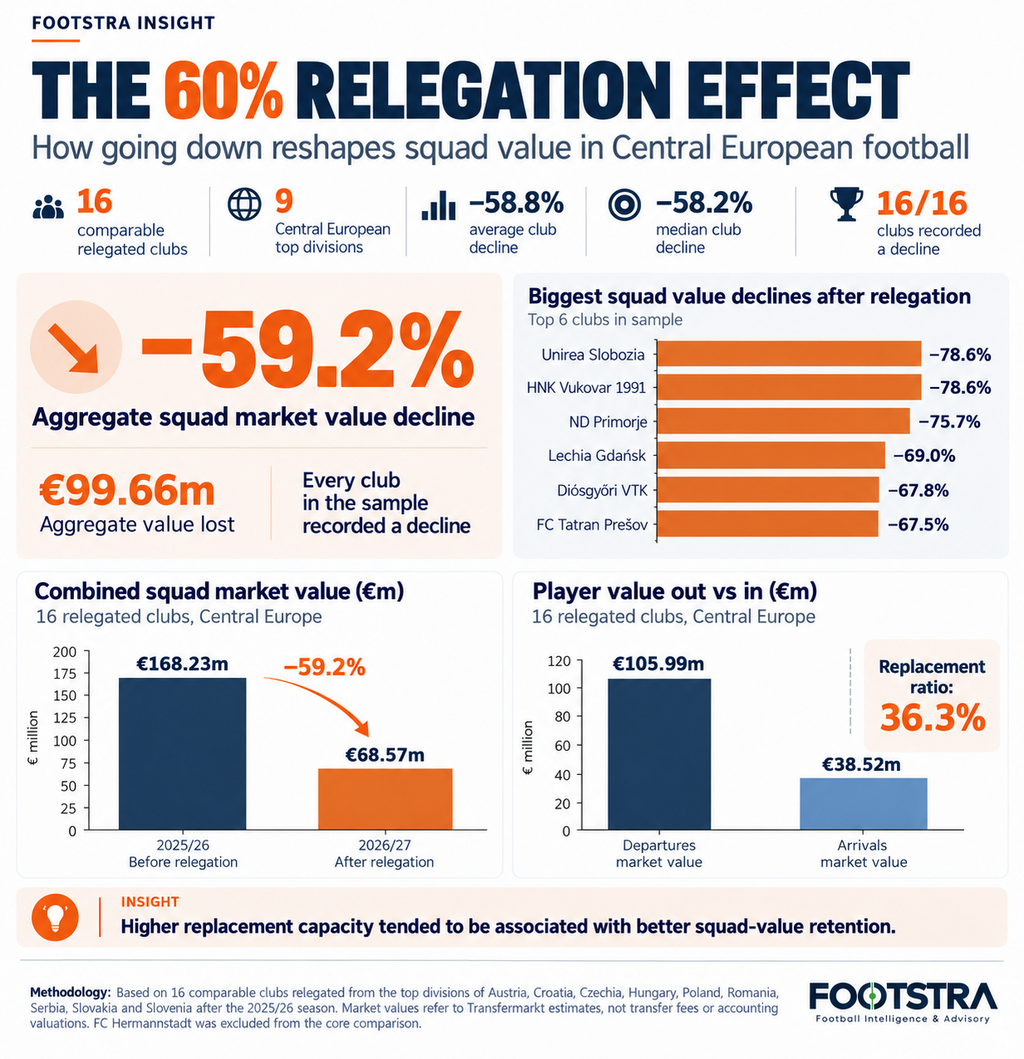
- Across 16 relegated clubs from nine Central European top divisions, combined squad market value fell from approximately €168.2 million to €68.6 million. That represents an aggregate decline of around 59.2%, with every club in the comparable sample recording a lower squad value after relegation.
- The decline was broad-based rather than driven by a handful of extreme cases. The average squad-value reduction was approximately 58.8%, while the median was around 58.2%, suggesting that the post-relegation reset was a common feature across the sample.
- Player replacement was significantly weaker than player outflow. The combined market value of departing players was approximately €106.0 million, compared with only €38.5 million in incoming player value — a replacement ratio of roughly 36%.
- Clubs that replaced a larger share of outgoing player value generally retained more squad value. While the sample is too small and heterogeneous to establish causation, the pattern suggests that post-relegation recruitment capacity may materially influence how much sporting value a club preserves.
- Higher pre-relegation squad value did not appear to provide protection against a large percentage decline. This indicates that resilience may depend less on how valuable the squad is before relegation and more on how effectively the club manages the financial, contractual and sporting transition afterwards.
- The central issue is not whether squad value falls after relegation. It is whether that decline is anticipated, financed and strategically managed through revenue planning, wage adjustment, player-retention priorities, regulatory compliance and recruitment strategy.
Relegation is usually discussed as a sporting failure.
But for football clubs, going down is rarely only about league position. It can trigger a broader economic reset: lower central distributions, reduced broadcasting exposure, weaker sponsorship leverage, lower matchday income, changes in public or institutional support, and a significant reassessment of squad costs.
That reset often becomes visible first in one of the club’s most important sporting assets: the playing squad.
Footstra examined 16 clubs relegated from nine Central European top divisions following the 2025/26 season to understand how squad market values changed after relegation — and what those changes may reveal about the wider economics of going down.
The result was striking.Across the sample, combined squad market value fell from approximately €168.2 million to €68.6 million.That represents a decline of around:
59.2%
In other words, relegation was followed by the loss of almost €100 million in aggregate squad market value across just 16 clubs. Yet the decline itself is only part of the story.
The more important question is:
why does squad value fall so sharply after relegation — and what can clubs do to manage that risk?
A widespread reset, not an outlier effect
The decline was not driven by one or two extreme cases. Every club in the comparable sample recorded a lower squad market value after relegation. The average decline was approximately 58.8%, while the median decline was around 58.2%.
That alignment matters. It suggests that the aggregate result is not simply being distorted by a small number of clubs experiencing unusually severe restructuring. Instead, the data point toward a broader pattern:
Relegation is frequently followed by a fundamental repricing and restructuring of the playing squad.
At the most severe end of the sample, Unirea Slobozia and HNK Vukovar 1991 both lost close to 79% of their squad market value.
ND Primorje declined by approximately 76%, while Lechia Gdańsk fell from €26.4 million to €8.18 million — a reduction of more than €18 million.
At the other end, Bruk-Bet Termalica Nieciecza retained considerably more value, with a decline of approximately 25%.
Even the most resilient clubs, however, still experienced meaningful contraction.
Why does relegation reduce squad value?
There is no single mechanism. Relegation changes several parts of a club’s operating environment at the same time. The most obvious is revenue. Top-flight football usually provides access to higher central distributions, greater broadcasting exposure, stronger sponsorship inventory, higher attendances and greater matchday revenue.
In some markets, clubs may also benefit from public, institutional or other funding structures that differ materially between divisions. Once relegation occurs, some of those revenue streams may decline immediately. Others may be renegotiated.
And while revenue can fall rapidly, the club’s cost base does not always adjust at the same speed.
Player wages, staff costs, contracts, infrastructure commitments and other fixed operating expenses may remain in place.
This creates a fundamental tension:
the club must operate with a lower revenue base while potentially carrying a squad designed for top-flight economics.
The playing squad therefore becomes one of the principal areas where financial adjustment can occur.
When sporting decisions become financial decisions
A club may want to retain its best players after relegation. Economically, that may not always be possible. Player contracts can contain mechanisms that become relevant after relegation, including salary reductions, release clauses or termination rights.
Even where no specific relegation clause exists, the club may conclude that certain salary levels are no longer sustainable in the second tier.
This can create pressure to sell higher-value players. From a sporting perspective, that may weaken the probability of immediate promotion. From a financial perspective, however, those sales may be necessary to reduce wages, generate liquidity and rebalance the club’s operating model.
This is where the sporting and economic sides of football become inseparable. A player sale following relegation is not necessarily evidence of reduced sporting ambition.
It may instead represent a rational response to a materially different financial environment.
€106 million out — €38.5 million in
The player-flow data provide another perspective on the scale of the adjustment.
Across the 16 clubs analysed, the combined market value of departing players was approximately: €106.0 million
The combined market value of incoming players was approximately: €38.5 million
The market value of incoming players therefore represented only around:36% of outgoing player value
Put differently: For every €1 of player market value leaving the relegated clubs, only around €0.36 arrived in replacement value.
This does not represent transfer fees.
It reflects the estimated market value of incoming and outgoing players.But the pattern is still informative. Rather than replacing departing talent on a like-for-like basis, many relegated clubs appear to undergo substantial squad downsizing.
That downsizing may take several forms:
lower salaries,
younger players,
domestic recruitment,
academy promotion,
free transfers,
lower-value profiles,
or players better suited to the economics and sporting requirements of the second division.
The regulatory environment can accelerate the reset
Relegation can also alter the regulatory context in which a club operates.Second divisions may have different requirements relating to squad composition, foreign players, home-grown players, younger players or eligibility for central or public funding.
In some competitions, financial incentives or public support may be linked to the use of domestic or youth players.
Where these mechanisms exist, squad restructuring can therefore be driven not only by financial necessity but also by regulatory optimisation.
A club may rationally replace a higher-value foreign player with a younger domestic player if doing so:
reduces payroll,
supports regulatory compliance,
improves eligibility for funding,
and fits the club’s revised sporting model.
The resulting decline in squad market value therefore does not automatically indicate poor management. In some cases, it may reflect deliberate adaptation.
Replacement capacity appears to matter
The data also reveal an interesting relationship between outgoing and incoming player value. Clubs that replaced a larger share of departing player market value generally tended to retain a larger proportion of their squad value.
For example, Bruk-Bet Termalica replaced approximately half of departing market value and recorded one of the smallest squad-value declines in the sample.
Arka Gdynia also retained a relatively high proportion of player value and experienced a smaller contraction than most clubs.
By contrast, clubs with very low replacement ratios frequently experienced some of the largest squad-value declines.
Across the sample, the relationship between replacement ratio and squad-value retention was moderately positive. This does not establish causation. The sample is small, leagues differ structurally, and transfer strategy is influenced by many factors.
But it does raise an important strategic question:
How much player value is a relegated club actually prepared — and able — to reinvest?
That decision may materially affect whether relegation becomes a temporary sporting setback or the beginning of a deeper restructuring cycle.
Bigger squads were not necessarily more resilient
Another notable finding is that a higher pre-relegation squad value did not appear to protect clubs from a large percentage decline.
Lechia Gdańsk entered the comparison with the highest squad value in the sample at €26.4 million, yet lost approximately 69% of that value. TSC Bačka Topola started above €20 million and declined by more than half.
Meanwhile, several lower-value squads retained a greater proportion of their value. The simple relationship between starting squad value and subsequent percentage decline was close to zero.
That matters because it suggests that resilience may depend less on how valuable the squad is before relegation and more on how the club is structured to respond once relegation occurs.
Relegation planning should begin before relegation
For club executives and ownership groups, this may be the most important implication. Relegation planning cannot realistically begin once relegation has already been confirmed.
By that point, contractual commitments are already in place. Player expectations have formed. Agents and buying clubs know the relegated club may be under pressure. Sponsor negotiations may already be changing. And management may be forced into reactive decisions under severe time pressure.
A more resilient club should therefore understand its relegation exposure before the final league table makes it unavoidable.
That includes modelling:
- the second-tier revenue base,
- likely central distribution changes,
- sponsorship downside,
- matchday revenue reductions,
- salary commitments,
- relegation clauses,
- player retention priorities,
- expected transfer income,
- required squad-cost reduction,
- replacement capital,
- regulatory requirements,
- and the financial cost of attempting immediate promotion.
The objective is not necessarily to preserve squad value at all costs. That could itself be financially irresponsible. The objective is to ensure that any reduction in sporting assets is planned rather than forced.
A decline in squad value is not automatically a failure
This distinction is important. A large reduction in squad value can represent poor preparation. But it can also represent intentional restructuring.
If a club enters the second tier with a substantially lower revenue base, maintaining a top-flight cost structure may create significantly greater long-term risk than accepting a short-term reduction in squad value.
A well-managed club may therefore deliberately reduce payroll, sell players with strong market demand, introduce academy players and rebuild around a more sustainable operating model.
In that context, the key question is not:
Did squad value fall?
It is:
Was the decline anticipated, financed and strategically managed?
That is the difference between restructuring and distress.
When the downside becomes more severe
FC Hermannstadt demonstrates why that distinction matters.
The club was excluded from the core squad-value comparison because it did not present a normal post-relegation second-tier squad structure for the 2026/27 season.
Its situation illustrates an extreme version of relegation risk.
In some cases, the downside is not simply a 40%, 60% or 80% decline in squad market value.
It can become a broader organisational and financial crisis.
That is precisely why relegation risk should be viewed as more than a sporting scenario. It is an enterprise-risk issue.
The broader lesson
Across the 16 comparable Central European clubs analysed by Footstra, relegation was followed by an aggregate squad-value decline of approximately 59%.
Nearly €100 million in playing-squad market value disappeared from the sample. Incoming player value replaced only around one-third of outgoing value. Yet the scale of decline varied substantially between clubs. That variation is where the strategic lesson lies.
Relegation does not reduce squad value in isolation. It changes the club’s financial environment, contractual position, recruitment possibilities, regulatory context and strategic priorities at the same time.
The squad-value decline is therefore best understood as one visible consequence of a much broader organisational reset.
For club owners and executives, the implication is clear:
Relegation planning is not only a sporting contingency exercise.
It is a financial, contractual, regulatory and squad-management problem that must be addressed before relegation makes the decisions unavoidable. The clubs that prepare for that scenario can choose how they restructure. The clubs that do not may have the restructuring chosen for them.
Methodology
Footstra analysed clubs relegated from the top divisions of Austria, Croatia, Czechia, Hungary, Poland, Romania, Serbia, Slovakia and Slovenia following the 2025/26 season.
Squad market values and incoming/outgoing player market values were collected from Transfermarkt and are used as indicative market estimates rather than accounting valuations or actual transfer fees.
FC Hermannstadt was excluded from the core comparative calculations because its post-relegation situation did not represent a normal operating second-tier squad for the 2026/27 season.
The resulting comparable sample consisted of 16 clubs. Differences in league structures, valuation dates, transfer-market timing, regulatory frameworks and club-specific circumstances mean the results should be interpreted as descriptive evidence rather than proof of a causal relationship between relegation and market value.
Footstra helps clubs and ownership groups model the financial, contractual and sporting consequences of relegation before they become operational problems. From squad-value exposure and cost restructuring to scenario planning and recovery strategy, we support decision-makers with independent football intelligence.
Turn insight into a decision.
Footstra provides independent football intelligence and strategic advisory for clubs, investors and industry stakeholders.