
When External Funding Becomes Uncertain: Sepsi OSK and FK Csíkszereda at a Financial Turning Point
Both clubs are competing in Romania’s top flight in 2026/27. But with Hungarian-origin support equivalent in scale to a substantial share of their revenue base, the central question is shifting from sporting growth to financial resilience.
Key findings
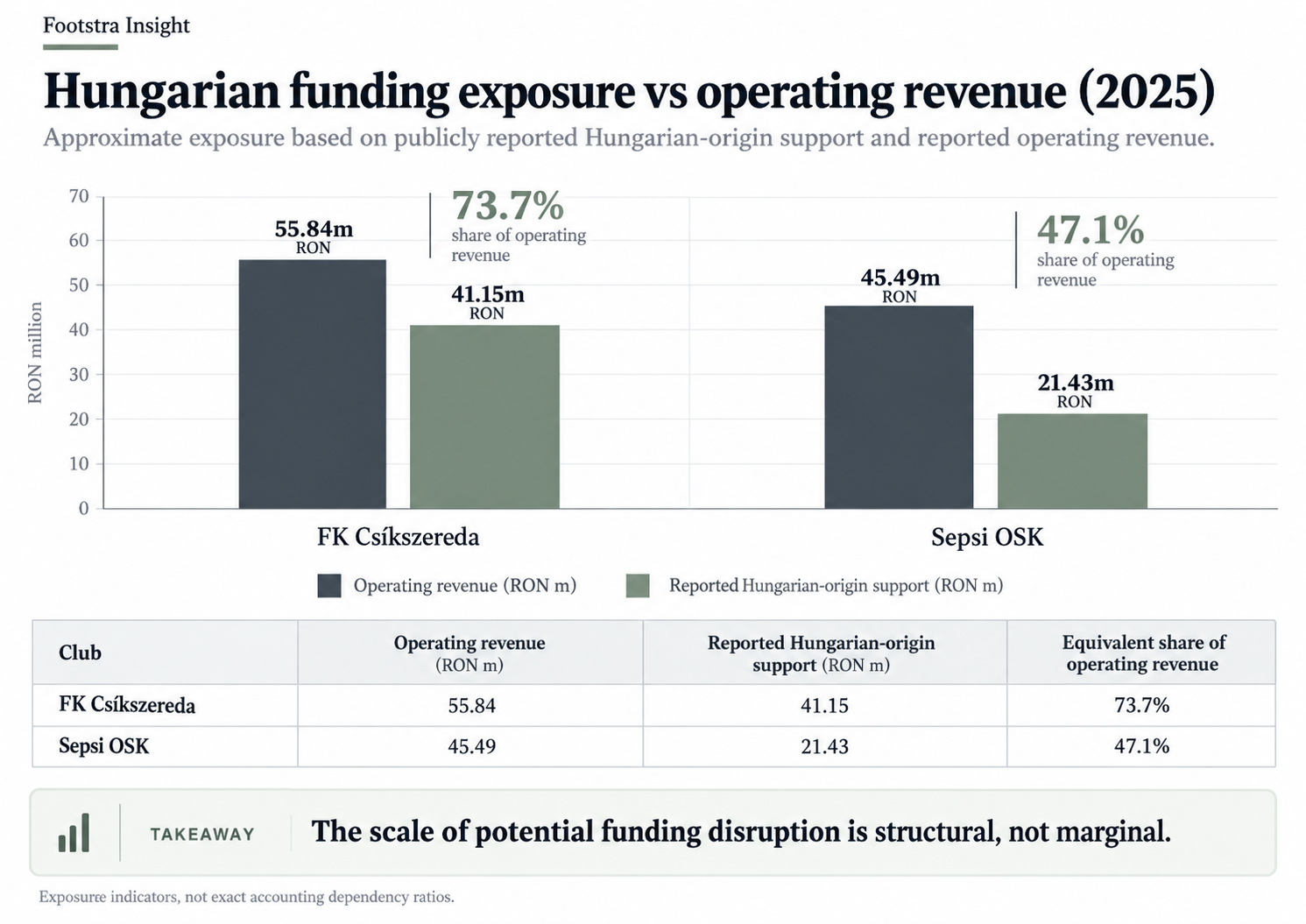
- The funding exposure is structural, not marginal. Hungarian-origin support reported around 2025 was equivalent in scale to approximately 74% of FK Csíkszereda’s and 47% of Sepsi OSK’s 2025 operating revenue. These are indicative exposure ratios, not exact accounting dependency ratios.
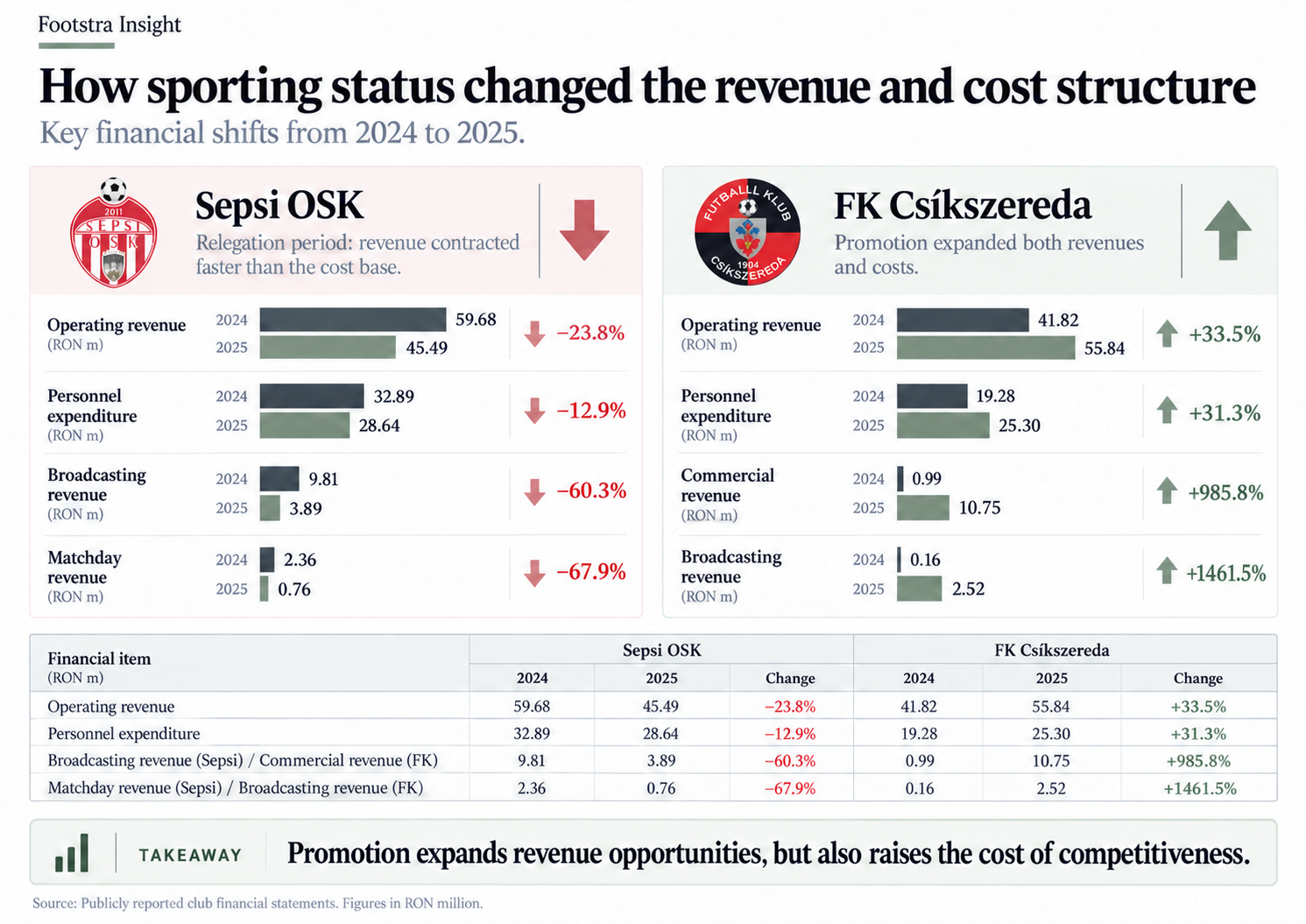
- Sporting status materially changes both revenue and cost. Csíkszereda’s operating revenue increased by 33.5% in 2025 as it moved into the top flight, while personnel expenditure increased by 31.3%. Sepsi experienced the reverse effect around relegation.
- Commercial growth helps, but does not automatically solve the funding problem. Promotion created a major uplift in Csíkszereda’s football-related revenues, but from a much smaller base than the scale of external support.
- The clubs are already following different squad-adjustment paths. Sepsi returned to the top flight with an older, experience-led squad, while Csíkszereda reduced aggregate squad value and shifted towards a younger replacement profile.
Sporting status changes the economics
The 2025 financial year provides an unusually useful comparison.
Sepsi OSK moved from Romania’s top division into Liga 2, while FK Csíkszereda moved in the opposite direction and entered the SuperLiga for the first time. Sepsi then secured an immediate return to the top flight in May 2026.
The financial consequences of those opposite sporting trajectories are already visible. At Sepsi, operating revenue declined from RON 59.68 million in 2024 to RON 45.49 million in 2025, a fall of 23.8%. Broadcasting revenue dropped by around 60%, while matchday income fell by almost 68%.
The cost base adjusted more slowly. Personnel expenditure declined from RON 32.89 million to RON 28.64 million, or 12.9%. In other words, revenue contracted considerably faster than the largest recurring sporting-cost category.
Csíkszereda experienced almost the mirror image.
Operating revenue increased from RON 41.82 million in 2024 to RON 55.84 million in 2025, or 33.5%, while personnel expenditure increased from RON 19.28 million to RON 25.30 million, or 31.3%. The club’s published accounts also show commercial revenue rising from RON 0.99 million to RON 10.75 million and broadcasting income from RON 0.16 million to RON 2.52 million.
Across matchday, sponsorship, broadcasting, commercial and UEFA-related categories, Csíkszereda’s reported revenue increased from approximately RON 1.83 million to RON 14.94 million.
The message is straightforward: Promotion materially expands the revenue opportunity — but it also raises the cost of remaining competitive. That relationship is central to understanding the clubs’ exposure to changes in external funding.
The scale of the funding exposure
Hungarian-origin support has historically represented a significant source of financing for both football organisations.
Reporting based on Romanian financial disclosures put the 2025 Hungarian-origin support at approximately €8.16 million for FK Csíkszereda and €4.25 million for Sepsi OSK.
Using the ECB’s average 2025 EUR/RON exchange rate of 5.0424, those amounts correspond to approximately RON 41.15 million and RON 21.43 million, respectively.
Against the clubs’ 2025 operating revenues, these figures correspond to indicative exposure ratios of approximately 73.7% for FK Csíkszereda and 47.1% for Sepsi OSK. These figures are striking, but they require an important methodological qualification.
The percentages are exposure indicators, not exact dependency ratios
Romanian financial statements are prepared for the calendar financial year, while several football-support programmes are allocated for a sporting season.
The clearest example is the sports-academy TAO programme: the Hungarian authorities reported that Csíkszereda received HUF 699.937 million and Sepsi HUF 494 million for the 2025/26 season. A 2025/26 sporting-season allocation therefore does not map exactly onto financial statements covering January to December 2025.
The 73.7% and 47.1% figures should consequently be interpreted as indicative measures of financial exposure and relative scale, not as claims that precisely 73.7% or 47.1% of the clubs’ accounting revenue in calendar year 2025 came from Hungarian support. This timing mismatch is important throughout the analysis.
One funding structure, several channels
The Hungarian funding system has also operated through several mechanisms. The €8.16 million and €4.25 million figures represent the broader Hungarian-origin support reported for 2025. Within that wider financing structure, the sports-academy TAO programme represented one specific component.
The HUF 699.937 million allocated to Csíkszereda and the HUF 494 million allocated to Sepsi for 2025/26 should therefore not be added on top of the €8.16 million and €4.25 million figures as though they were separate, entirely additional funding streams. Public reporting explicitly describes the TAO amounts as only one part of the wider Hungarian financing received by the organisations.
The future of this financing model is now uncertain. The Hungarian authorities stated in July 2026 that sports-support programmes, including funding for cross-border football academies, were being reviewed. No permanent termination was formally announced, but continuation under the previous model was not guaranteed either.
For club management, uncertainty alone has consequences.
Football organisations commit to player contracts, academy programmes and operating structures before they know their final sporting result. A significant source of financing becomes much harder to incorporate into multi-year planning when its future level and timing cannot be forecast reliably.
How visible is the dependency in the accounts?
At Sepsi, the exposure is relatively easy to see in the reported revenue structure. The club recorded approximately RON 21.36 million in subsidies, donations and related income in 2025, close in scale to the externally reported Hungarian-origin support figure after conversion into lei.
At Csíkszereda, the accounting picture is less transparent. Its 2025 accounts report RON 39.13 million of “other operating revenue”, equivalent to roughly 70% of total operating revenue.
That amount is very close in magnitude to the approximately RON 41 million equivalent of the reported Hungarian-origin support.
However, the published accounts do not disaggregate the “other operating revenue” line sufficiently to establish a direct one-to-one reconciliation. The appropriate conclusion is therefore not that RON 39.13 million can definitively be labelled Hungarian funding. It is that both the external reporting and the clubs’ financial statements point to a substantial concentration of revenue around externally financed sources.
Can commercial growth compensate?
Csíkszereda offers an important real-world test. Promotion produced a dramatic increase in identified football-related revenue. The combined total of matchday, sponsorship, broadcasting, commercial and UEFA-related revenue rose from approximately RON 1.8 million to RON 14.9 million in one year.
That is a major commercial improvement.
Yet it also illustrates the scale of the challenge. Hungarian-origin support reported around the same period was equivalent to approximately RON 41 million. Because the funding and accounting periods do not align perfectly, this should not be treated as a mechanical replacement calculation. But the comparison still demonstrates the relative magnitude involved.
At the same time, personnel expenditure rose by 31.3%.
The strategic question is therefore not simply whether promotion generates more revenue.
It is:
Can recurring football revenues grow faster than the cost required to remain competitive?
Sepsi illustrates the opposite side of that mechanism. Relegation produced rapid reductions in broadcasting and matchday income, while personnel expenditure adjusted more slowly.
There is also a second issue: not every item labelled “sponsorship” should automatically be treated as fully independent replacement revenue.
László Diószegi has publicly referred to Hungarian companies and supporters with advertising agreements as part of Sepsi’s historical funding environment. Financial diversification therefore means reducing concentration not only by revenue category, but also by funding network and geography.
Two different squad-adjustment strategies
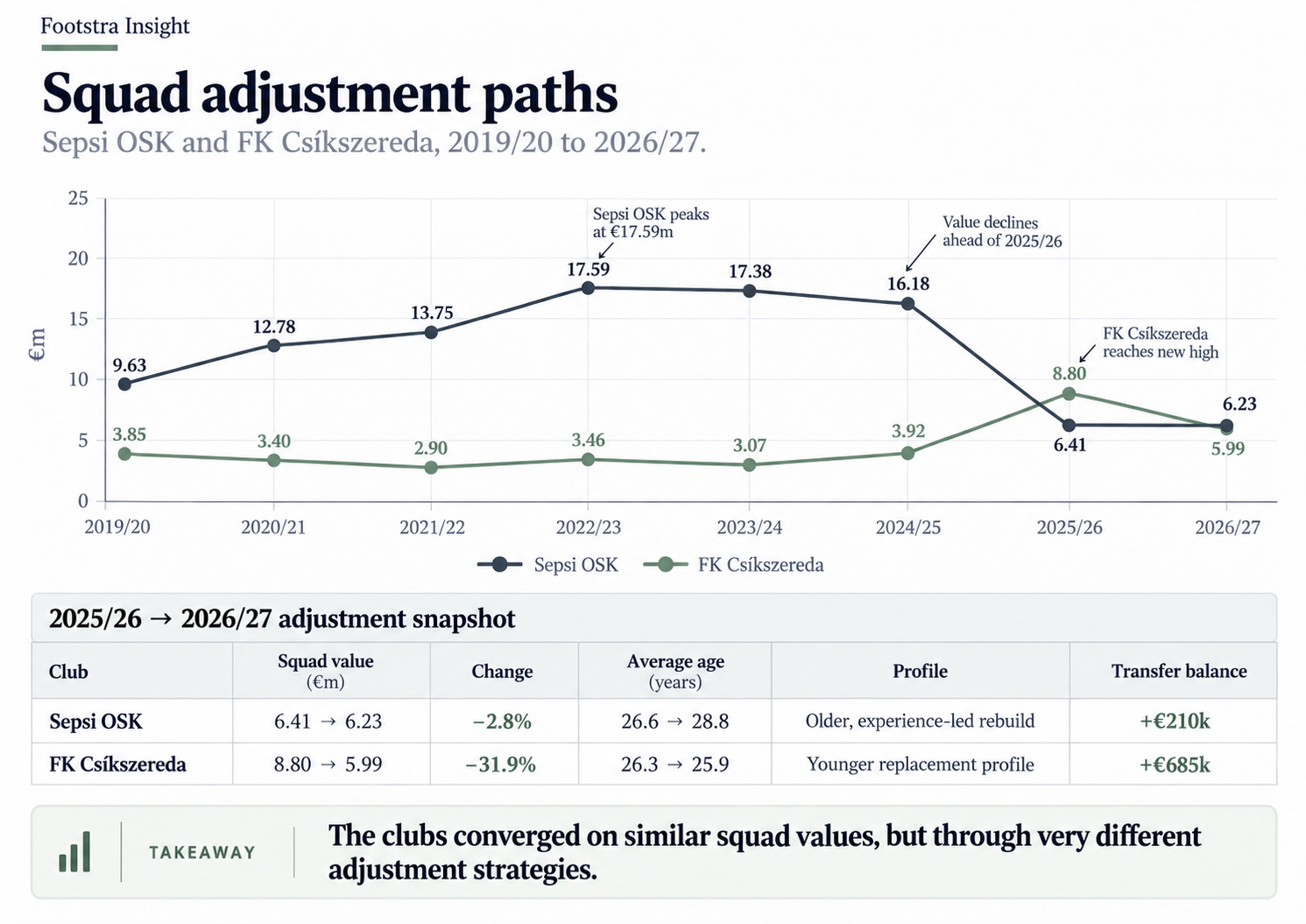
The playing squads provide another indication of how the two clubs have adjusted. Sepsi’s estimated squad value stood at €16.18 million in 2024/25. Following relegation, it dropped to €6.41 million in 2025/26, a decline of approximately 60%.
Despite immediate promotion back to the SuperLiga, the estimated value remained almost unchanged at €6.23 million in 2026/27.
The profile changed instead. The squad’s average age increased from 26.6 to 28.8 years. The underlying turnover points to an experience-led rebuild without recreating the previous €15–17 million asset base.
Csíkszereda took a different route. Its estimated squad value increased from €3.92 million in 2024/25 to €8.80 million in 2025/26 after promotion, before declining to €5.99 million in 2026/27, despite the club remaining in the top division.
The overall average age moved from 26.3 to 25.9, while the replacement cohort was younger than the outgoing group. The 2026/27 Transfermarkt snapshot also reports a positive transfer balance of approximately €685,000.
This does not prove that funding uncertainty caused the restructuring. It does show that Csíkszereda entered its second top-flight season with lower aggregate squad value, a younger replacement profile and a positive transfer balance — a combination consistent with more conservative sporting capital allocation.
By 2026/27, the two clubs had effectively converged:
Sepsi OSK: €6.23 million
FK Csíkszereda: €5.99 million
Similar values, but very different adjustment paths.
The real issue is predictability
The central risk is therefore not simply the potential disappearance of one grant. It is the interaction between funding concentration, sporting volatility and multi-year cost commitments.
A full withdrawal of support equivalent in scale to roughly three quarters of annual operating revenue at one organisation and almost half at the other would require a structural response: replacement funding, higher recurring football revenues, cost adjustment, or a combination of all three.
But even partial reductions create planning problems when the timing is unclear. That is why the calendar-year versus sporting-season distinction matters so much. The financial statements provide a reliable picture of what was recognised during the accounting year; the funding programmes reflect a different operational cycle.
The comparison cannot therefore deliver a precise “dependency percentage”, but it can reveal whether the order of magnitude is financially material. In both cases, it clearly is. Top-flight football can materially increase football-related revenues, but commercial growth alone does not remove funding risk when the cost of competitiveness rises at the same time.
Sepsi has demonstrated how quickly revenues can contract after relegation. Csíkszereda has demonstrated how quickly both revenues and costs can rise following promotion.
For both clubs, the strategic challenge is therefore moving from growth supported by concentrated external capital towards resilience built on diversified recurring income, adaptable sporting costs and sustainable player trading.
The question is no longer whether external funding helped build competitive football organisations. It is whether those organisations can remain competitive when that funding becomes significantly less predictable.
What does funding resilience look like in your club or target market?
Footstra provides independent club intelligence and financial-structural assessments, examining revenue concentration, ownership exposure, sporting cost structures and the sustainability of growth.
Request a confidential assessment tailored to your club, investment target or market.
Sources
Club financial statements
Sepsi OSK — consolidated financial statements, with the 2024 and 2025 reporting periods used for the core financial comparison; earlier statements were reviewed for historical context.
FK Csíkszereda — annual financial statements, with the 2024 and 2025 reporting periods used for the core financial comparison; earlier statements were reviewed for historical context.
Squad data
Transfermarkt — season-level squad market values, average age and transfer-balance data for Sepsi OSK and FK Csíkszereda.
Hungarian-origin funding and policy status
Transtelex, 23 July 2026 — review of cross-border football-support programmes and related club-management statements.
24.hu, 23 July 2026 — 2025/26 sports-academy TAO allocations.
HVG, 23 July 2026 — broader Hungarian-origin funding figures reported for 2025.
Exchange rate
European Central Bank — 2025 annual average EUR/RON reference exchange rate.
Turn insight into a decision.
Footstra provides independent football intelligence and strategic advisory for clubs, investors and industry stakeholders.
Discuss a confidential assessment →